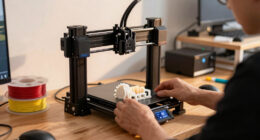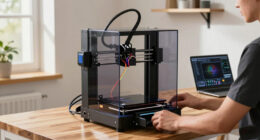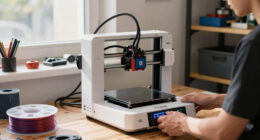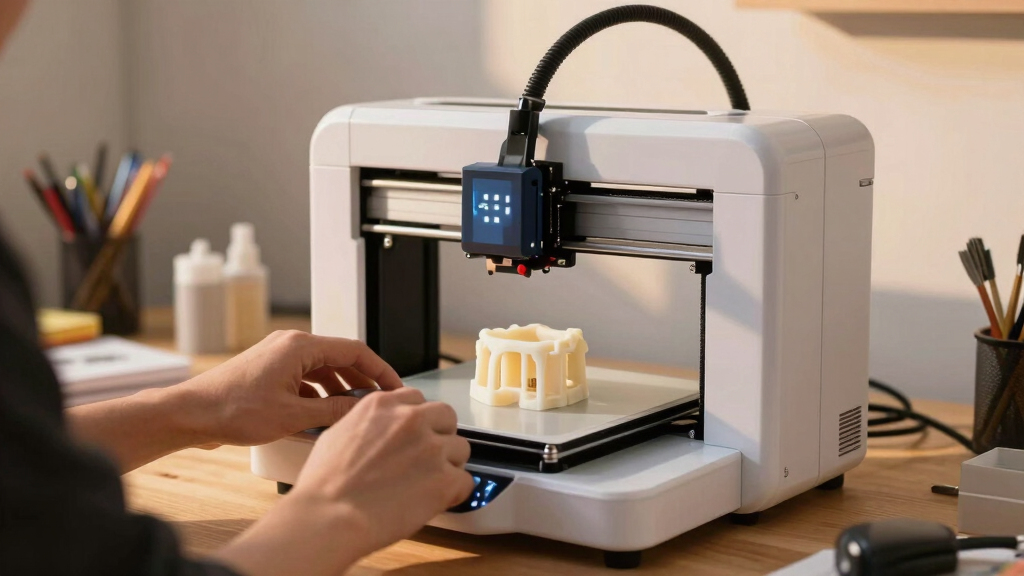
If you’re a prototype seller, finding the best 3D printer means balancing speed, precision, and ease of use. The FLASHFORGE Adventurer 5M stands out for its auto-leveling and high-speed capabilities, making it ideal for rapid iteration. The Bambu Lab P1S offers support for multi-material printing and excellent accuracy, perfect for complex prototypes. Meanwhile, the AOSEED 3D Printer provides an affordable, kid-friendly option with impressive features for educational and small-scale projects. These choices reflect common tradeoffs: faster printers may sacrifice some detail, while multi-material support often comes at a higher cost. Continue reading for a full breakdown of these top options and what makes each one unique.

Get smart everyday buys delivered free with Prime
- Fast, free delivery on millions of items
- Prime Video, Amazon Music and more included
- Member-only deals all year
Key Takeaways
- Speed and precision are critical, with some printers reaching 600mm/s but often with tradeoffs in detail quality.
- Multi-material support, especially for colors, adds value but usually increases price and complexity.
- Auto-leveling features significantly reduce setup time, boosting productivity for prototype workflows.
- Build volume varies; larger sizes are useful for bigger prototypes but may come with higher costs and slower print speeds.
- Ease of use and assembly matter; fully assembled models save time but can limit customization options.




More Details on Our Top Picks
FLASHFORGE Adventurer 5M 3D Printer with Fully Auto Leveling, Max 600mm/s High Speed Printing, 280°C Direct Extruder with 3S Detachable Nozzle, CoreXY All Metal Structure, Print Size 220x220x220mm
This model stands out for its exceptional combination of speed, accuracy, and user-friendly features, making it ideal for prototype sellers who need rapid turnaround times. Unlike the Bambu Lab P1S, it offers faster speeds (600mm/s vs. 500mm/s) and a fully automatic bed leveling system, reducing setup time and errors. Its direct drive extruder with a detachable nozzle simplifies maintenance and material versatility. However, the high-speed operation results in significant noise and potential vibrations, which could be disruptive in a quiet workspace. Compared with the Flashforge AD5X, the 5M is more accessible for smaller-scale operations and easier for non-experts to operate. The main tradeoff involves noise and the necessity for regular maintenance in high-speed mode.
Pros:- Blazing fast print speeds up to 600mm/s for rapid prototyping.
- Fully automatic bed leveling ensures consistent first layers.
- High precision with stable all-metal CoreXY structure.
Cons:- Significant noise levels due to high-speed operation and fans.
- Requires regular maintenance for optimal performance.
- Limited Wi-Fi support, relying mostly on physical connections.
Best for: Prototyping businesses requiring fast, precise prints with minimal manual intervention.
Not ideal for: Small offices or quiet environments where noise and vibration are problematic.
- Print Size:220x220x220mm
- Max Speed:600mm/s
- Extruder Temperature:280°C
- Nozzle Options:3S Detachable Nozzle
- Build Structure:CoreXY All Metal
- Connectivity:Mobile App Monitoring
Bottom line: This printer is best suited for professional prototype sellers who prioritize speed and accuracy over noise levels.
Bambu Lab P1S 3D Printer, Fully Enclosed, Support Up to 16 Colors/Multi Materials, 500mm/s Fast Printing & High Precision, CoreXY & Auto Bed Leveling, Ready-to-Use FDM 3D Printers Large Print Size
The Bambu Lab P1S excels in enabling complex, multi-material prototypes with support for up to 16 colors, ideal for detailed visual models. Its enclosed design improves print stability and reduces environmental impact, unlike the open-frame Flashforge Adventurer 5M. The auto bed leveling simplifies setup, making it suitable for teams seeking high throughput without extensive calibration. While it supports a wide range of filaments, it’s not recommended for carbon-reinforced materials. Compared to the Flashforge AD5X, the P1S emphasizes multi-material versatility at a slightly lower maximum speed (500mm/s vs. 600mm/s). Its main drawback is the higher price point, which may be a barrier for smaller operations.
Pros:- Supports up to 16 colors for vibrant, complex prototypes.
- Fully enclosed design for enhanced stability and safety.
- Auto bed leveling for quick, accurate setup.
Cons:- Higher cost compared to single-material printers.
- Limited support for fiber-reinforced filaments.
- Maximum speed slightly lower than some competitors.
Best for: Prototyping labs that need multi-color/multi-material capabilities with reliable high-speed printing.
Not ideal for: Producers working with reinforced or composite filaments like carbon fiber, which it doesn’t support well.
- Print Size:220x220x220mm
- Max Speed:500mm/s
- Number of Colors:Up to 16
- Build Structure:Enclosed CoreXY
- Material Support:PLA, PETG, TPU, PVA, PAE, ABS
- Auto Bed Leveling:Yes
Bottom line: Ideal for professional environments needing multi-material, multi-color output without sacrificing speed.
AOSEED 3D Printer for Kids, AI-Powered Fully Assembled 3D Printer with Up to 400mm/s Speed, Auto Leveling, 1500+ Models & 17+ Modules, Includes 8 PLA Filaments for Home and School Use, X-MAKER JOY AI+
This compact and AI-enabled printer makes 3D modeling accessible for children and beginners, unlike traditional models. Its voice and image prompts allow kids to create models easily, fostering early prototyping skills. The automated leveling and safety features make it user-friendly, especially for schools and homes. While it offers impressive speeds up to 400mm/s, it may struggle with larger, more intricate professional prototypes. Its enormous library of models and modules provides endless creative options, but the focus on simplicity may limit detailed technical prototyping. Compared with the Flashforge Adventurer 5M, the AOSEED prioritizes ease of use and educational value over raw speed and precision, making it less suitable for industrial prototyping.
Pros:- AI-powered model creation from voice, text, or images.
- Fast print speeds up to 400mm/s for quick projects.
- Includes extensive model library and modules for creativity.
Cons:- Limited build volume unsuitable for large prototypes.
- Less precision for detailed or functional parts.
- Designed primarily for educational use, not industrial-grade work.
Best for: Educational settings, families, and beginners exploring basic prototype development.
Not ideal for: Prototypers needing detailed, high-precision parts or working with advanced materials.
- Print Speed:Up to 400mm/s
- Build Volume:1500+ models & modules
- Filament Included:8 PLA rolls
- Auto Leveling:Yes
- Connectivity:Wi-Fi & App Control
- Model Library:Over 1,500 models
Bottom line: Best suited for educational environments and families seeking easy, rapid prototyping for fun and learning.
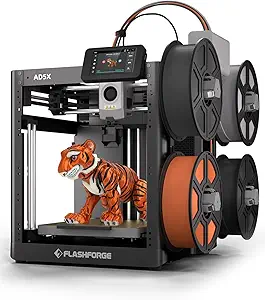
FLASHFORGE AD5X Multi-Color 3D Printer, CoreXY 600mm/s High-Speed, 1-Click Auto Leveling, 300°C Direct Drive Extruder, 220x220x220mm Build Volume, Ideal for Precision and Efficiency
The AD5X offers a compelling mix of multi-color capability and rapid production, rivaling the Flashforge Adventurer 5M but with added multi-material support. Its support for up to four colors simultaneously makes it perfect for visual prototypes requiring color differentiation, unlike the single-color Flashforge models. Its 600mm/s speed surpasses many competitors, including the Bambu Lab P1S, making it highly efficient for batch prototyping. The auto bed leveling and direct drive extruder streamline setup and maintenance. Nonetheless, the high-speed operation can cause vibrations, impacting precision on delicate parts. Compared to the Adventurer 5M, the AD5X emphasizes color versatility over extreme speed, with a slight tradeoff in noise levels and complexity.
Pros:- Supports up to 4 colors for complex, colorful prototypes.
- High-speed printing at 600mm/s for fast production cycles.
- One-click auto bed leveling for quick setup.
Cons:- Potential vibration issues affecting small, detailed parts.
- Higher complexity and cost compared to single-color models.
- Limited support for fiber-reinforced filaments.
Best for: Prototypers needing multi-color, rapid-turnaround models without high-cost investment.
Not ideal for: Producers working with high-performance reinforced or composite filaments.
- Print Size:220x220x220mm
- Max Speed:600mm/s
- Color Capability:Supports 4 colors
- Build Structure:CoreXY
- Extruder Temp:300°C
- Auto Bed Leveling:Yes
Bottom line: Best for cost-effective, multi-color rapid prototyping with high efficiency needs.
FLASHFORGE Adventurer 5M Pro 3D Printer with 1 Click Auto Printing System, 600mm/s High-Speed, Quick Detachable 280°C Nozzle, Core XY All-Metal Structure, Multi-Functional 220x220x220mm 3D Printer
The Adventurer 5M Pro extends the capabilities of the standard 5M with faster speeds (600mm/s) and support for diverse materials, making it suitable for functional and complex prototypes. Its pressure-sensing auto-leveling system eliminates manual calibration, expediting setup, unlike the AOSEED for beginners. The all-metal frame and multiple nozzle sizes (0.25mm to 0.8mm) provide versatility for detailed and large parts. Its high-speed operation is balanced with a robust print quality, supporting materials like ABS, PETG, and even composite filaments. The integrated app allows remote control and real-time monitoring, streamlining workflows. The main tradeoff involves higher complexity and cost, making it less ideal for casual or educational use compared to simpler models.
Pros:- Supports multiple nozzle sizes for detailed or large parts.
- Fast print speeds up to 600mm/s for efficient production.
- Automated pressure-sensing auto leveling for quick setup.
Cons:- Higher price point and complexity for beginners.
- Requires regular maintenance for high-speed operation.
- Potentially noisy operation due to high speeds and multiple fans.
Best for: Professional prototyping teams needing fast, multi-material, high-precision parts with minimal manual adjustments.
Not ideal for: Small-scale hobbyists or educational environments with limited budgets and simpler needs.
- Print Size:220x220x220mm
- Max Speed:600mm/s
- Nozzle Sizes:0.25mm to 0.8mm
- Material Support:PLA, ABS, PETG, ASA, TPU, PC
- Auto Leveling:Pressure sensing
- Build Structure:Core XY, All-metal
Bottom line: This is the best choice for professional, high-speed, multi-material prototyping with advanced features.
Entina TINA2S 3D Printers with WiFi Cloud Printing, Fully Assembled with Auto Leveling, Huge Library, DIY Mini 3D Printer for Beginners and Kids
This compact, fully assembled 3D printer stands out for its simplicity and user-friendly features tailored to newcomers, kids, and home users. Unlike the Creality Ender 3, which requires assembly and more technical setup, the Tina2S is designed for frustration-free operation; no calibration or extensive setup is needed. Its support for WiFi cloud printing and a library of over 1,500 models makes it perfect for quick starts and STEM activities. However, the tradeoff is its small build volume, limited to small projects, and open-source design may not appeal to users seeking a closed, commercial-grade machine. It excels in educational settings and quick prototyping for small ideas, but not for large-scale or industrial prototypes.
Pros:- Instant out-of-the-box use with no calibration required
- Supports app, USB, TF card, and WiFi workflow for versatile file transfer
- Auto leveling and flexible build plate simplify printing and cleanup
- Supports a large library of printable models and STEM activities
Cons:- Limited print volume of just 3.9 x 4.7 x 3.9 inches, unsuitable for larger prototypes
- Open-source design may lack the robustness needed for heavy-duty or professional use
- Lacks advanced features like high-temperature extruders or industrial-grade materials
Best for: Beginners, educators, and families seeking an easy, plug-and-play 3D printing experience.
Not ideal for: Prototypers needing large, high-precision prints or industrial-grade reliability.
- Build Volume:3.9 x 4.7 x 3.9 inches
- Print Speed:200mm/s
- Precision:0.04mm
- Connectivity:WiFi, USB, TF card
- Auto Leveling:Yes
- Supported Models:1500+
- Design:Open-source
- Build Plate:Flexible spring steel
- Weight:9.08 pounds
Bottom line: This printer makes the most sense for educators and hobbyists prioritizing ease of use over large-scale production or high precision.
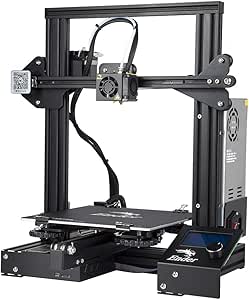
Official Creality Ender 3 3D Printer Fully Open Source with Resume Printing Function DIY Printers Build Volulme 8.66×8.66×9.84 inch
The Ender 3 is renowned for its affordability, open-source flexibility, and decent build volume, making it a solid choice for emerging prototypers and hobbyists. Compared with the Entina TINA2S, which is aimed at beginners and educational settings, the Ender 3 offers a larger print area and a more customizable platform, though at the cost of more setup and maintenance. Its resume printing feature provides a safety net during power outages, a plus for those working on longer prototypes. Nonetheless, it requires assembly and calibration, which can be challenging for absolute beginners, and its open frame design offers less safety and noise insulation. It’s best suited for those willing to tinker and upgrade for higher accuracy or larger prototypes.
Pros:- Large build volume of 8.66 x 8.66 x 9.84 inches for bigger prototypes
- Resume printing function offers safety during power failures
- Open-source design allows extensive customization and upgrades
- Supports a wide range of filaments and materials
Cons:- Requires assembly and calibration, which can be time-consuming and tricky for newcomers
- Open frame design exposes moving parts, reducing safety and increasing noise
- Basic out-of-the-box accuracy may require upgrades for high-precision prototypes
Best for: Budget-conscious hobbyists and small startups wanting a customizable and expandable prototyping platform.
Not ideal for: Professionals seeking a turnkey solution with minimal setup or those needing industrial-grade reliability.
- Build Volume:8.66 x 8.66 x 9.84 inches
- Print Speed:Maximum 600mm/s
- Resume Printing:Yes
- Frame:All-metal, open-frame
- Extruder:Upgraded with advanced technology
- Power Supply:Protected
- Assembly:Partial, about 2 hours
- Connectivity:SD card, USB
- Weight:15.43 pounds
Bottom line: This printer is better suited to prototyping enthusiasts who are comfortable with some setup and willing to upgrade for finer detail.