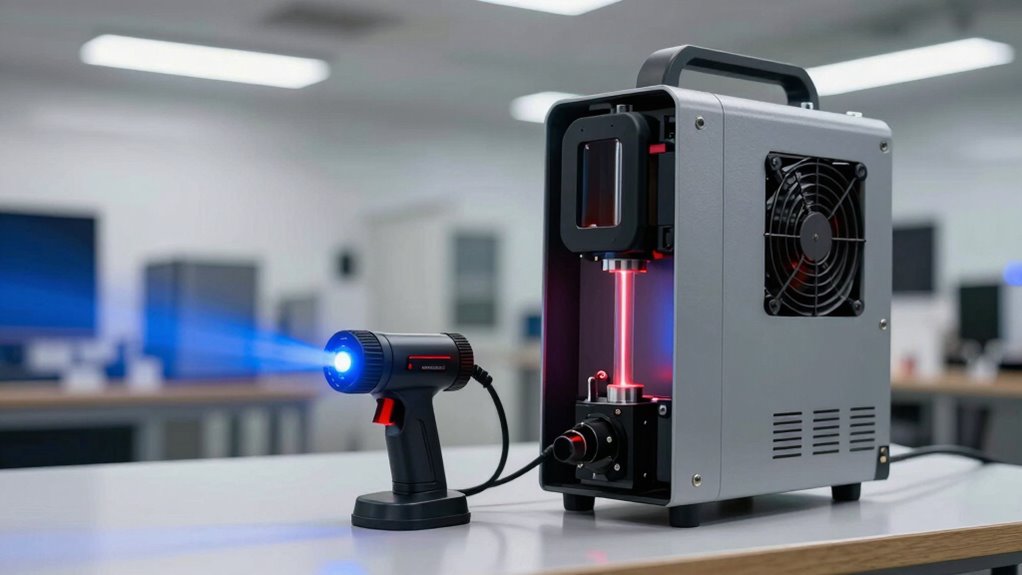

If you’re a small business, a diode laser might be the better choice due to its compact size, lower cost, and easier maintenance, making it safer and more budget-friendly. It’s ideal for simpler tasks and thinner materials. However, if you need to cut thicker materials or require higher precision, a CO2 laser offers better performance but comes with higher costs and more safety precautions. Keep exploring to find out which laser matches your specific needs and workspace better.

Get smart everyday buys delivered free with Prime
- Fast, free delivery on millions of items
- Prime Video, Amazon Music and more included
- Member-only deals all year
Key Takeaways
- Diode lasers are more compact, portable, and space-efficient, ideal for small business setups with limited workspace.
- Lower initial cost and reduced maintenance make diode lasers more budget-friendly for startups.
- Diode lasers have safer handling protocols, reducing the need for extensive safety measures and training.
- CO2 lasers offer higher power and material versatility but require more space, safety measures, and higher investment.
- Choose based on project needs: diode lasers suit simple, low-power tasks; CO2 lasers excel with thicker, high-quality cuts.
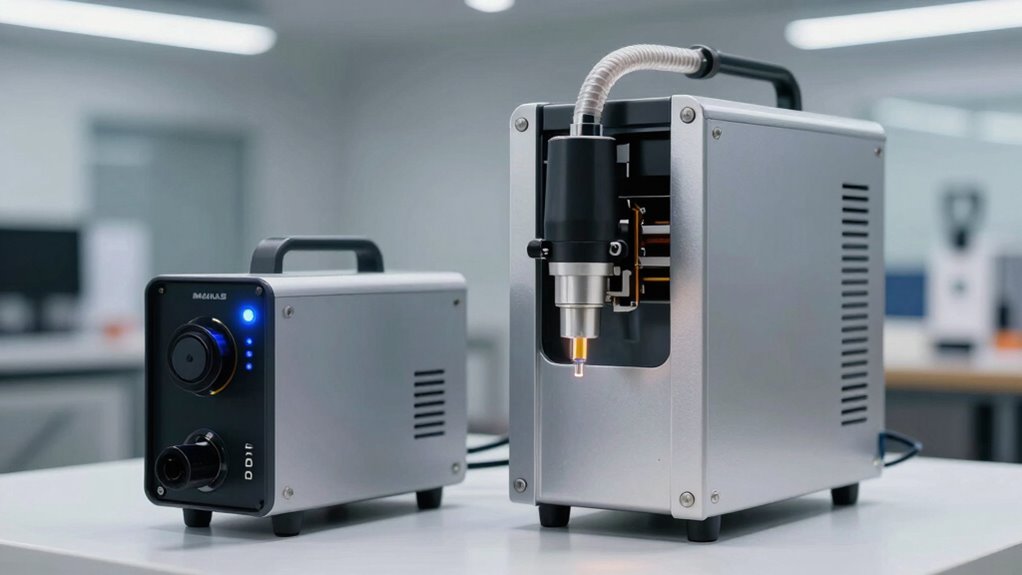
Are you wondering which laser technology suits your needs best? Choosing between a diode and a CO2 laser depends on several factors, especially when you’re running a small business. Both types have their strengths, but understanding their differences can help you make a well-informed decision. First, consider the laser safety protocols you’ll need to follow. Diode lasers tend to be more compact and operate at lower power levels compared to CO2 lasers, which makes them generally safer to handle and requires less stringent safety measures. However, regardless of the type, you must always prioritize laser safety—wear proper eye protection, ensure proper ventilation, and train your staff thoroughly to prevent accidents. Additionally, laser safety protocols are essential to prevent accidents and ensure compliance with safety standards. It’s also important to evaluate the cost of ownership over time, as it can significantly impact your overall investment. Maintenance requirements are another essential aspect. Diode lasers typically have fewer moving parts and are built with solid-state technology, making them easier and cheaper to maintain over time. You might find that diode lasers need less frequent servicing and have a longer lifespan with proper care. On the other hand, CO2 lasers, with their more complex optical systems and higher power output, often demand more regular maintenance. They might require more frequent alignment, cleaning of the laser tube, and replacement of parts, which can be time-consuming and costly for a small business. When it comes to operational costs, diode lasers usually have lower initial purchase prices and reduced ongoing maintenance expenses. This makes them an attractive option if you’re just starting out or working with a limited budget. CO2 lasers, while often more expensive upfront, are known for their ability to handle thicker materials and produce high-quality cuts, which can be beneficial in certain applications. Still, the higher maintenance requirements and safety considerations could mean more downtime and added costs over time. Size and space are also essential considerations. Diode lasers are smaller and more portable, fitting comfortably into tight workspace setups. CO2 lasers tend to be larger and require dedicated space, ventilation, and more robust safety measures. If your small business operates in a compact environment, a diode laser might be easier to integrate into your existing workspace. Additionally, technological advancements in laser systems continue to improve both types, offering new options for small business owners. It’s worth noting that technology evolution has led to better, more efficient laser systems, making both types more accessible and reliable than ever before. Ultimately, your choice will hinge on your specific needs—what materials you plan to work with, budget constraints, space limitations, and safety protocols. If you want a low-maintenance, cost-effective solution that’s easier to operate safely, a diode laser might be the better fit. However, if your projects demand higher power and precision, and you can accommodate the safety and maintenance requirements, a CO2 laser could serve you better. Assess your priorities carefully, and you’ll find the laser technology that aligns best with your small business goals.
diode laser engraver for small business
As an affiliate, we earn on qualifying purchases.
As an affiliate, we earn on qualifying purchases.
Frequently Asked Questions
What Is the Typical Lifespan of Each Laser Type?
You can expect a diode laser to last around 20,000 to 50,000 hours, thanks to its high laser power and durability, making it a reliable choice for small businesses. CO2 lasers generally have a lifespan of about 10,000 to 20,000 hours, but with proper maintenance, they can also be quite durable. Your choice depends on your usage needs, but both offer solid lifespan durability for ongoing work.
Which Laser Is More Energy-Efficient for Small Businesses?
You’ll find that diode lasers are more energy-efficient for small businesses, consuming less power and generating less heat. This makes them safer to operate and easier to maintain, aligning with laser safety standards. Additionally, diode lasers have a lower environmental impact since they use less energy and produce fewer emissions. Choosing a diode laser helps you save on energy costs while supporting eco-friendly practices, making it a smarter, safer investment.
How Much Maintenance Do Diode and CO2 Lasers Require?
You’ll find diode lasers require less maintenance, mainly needing routine cleaning and occasional part replacements, which helps with laser safety. They also have minimal cooling requirements, often using air cooling systems. In contrast, CO2 lasers demand more extensive upkeep, including laser safety checks and water cooling systems to prevent overheating. Regular maintenance ensures both types operate safely and efficiently, but diode lasers generally offer a simpler, less demanding upkeep process for small businesses.
Are There Specific Materials Better Suited for Each Laser?
You’ll find diode lasers excel with materials like plastics, fabrics, and thin woods due to their material versatility and laser precision, making them ideal for detailed work. CO2 lasers are better suited for thicker materials like acrylic, glass, and thicker woods, offering high precision for larger or more complex projects. Understanding each laser’s material strengths helps you choose the right machine to meet your small business needs effectively.
What Are the Initial Costs of Diode Vs CO2 Laser Systems?
Coincidentally, your initial costs for diode lasers are typically lower, often ranging from $2,000 to $10,000, making them more accessible for small businesses. CO2 lasers usually start at $10,000 and can go much higher, depending on power output and features. Keep in mind, laser safety measures and necessary maintenance also influence total expenses, so consider these factors when planning your investment.
CO2 laser cutter for thick materials
As an affiliate, we earn on qualifying purchases.
As an affiliate, we earn on qualifying purchases.
Conclusion
Choosing between a diode and CO2 laser is like selecting the right brush for your masterpiece—each has its unique stroke. Your small business’s needs and vision are the canvas guiding your choice. Think of the diode as a nimble squirrel, perfect for quick, detailed work, while the CO2 is a mighty oak, ready to carve out larger, bold projects. Whichever you pick, remember it’s your tool to paint your future—boldly and beautifully.
As an affiliate, we earn on qualifying purchases.
laser safety glasses for laser cutters
As an affiliate, we earn on qualifying purchases.
As an affiliate, we earn on qualifying purchases.
Halloween Picks
halloween
As an affiliate, we earn on qualifying purchases.