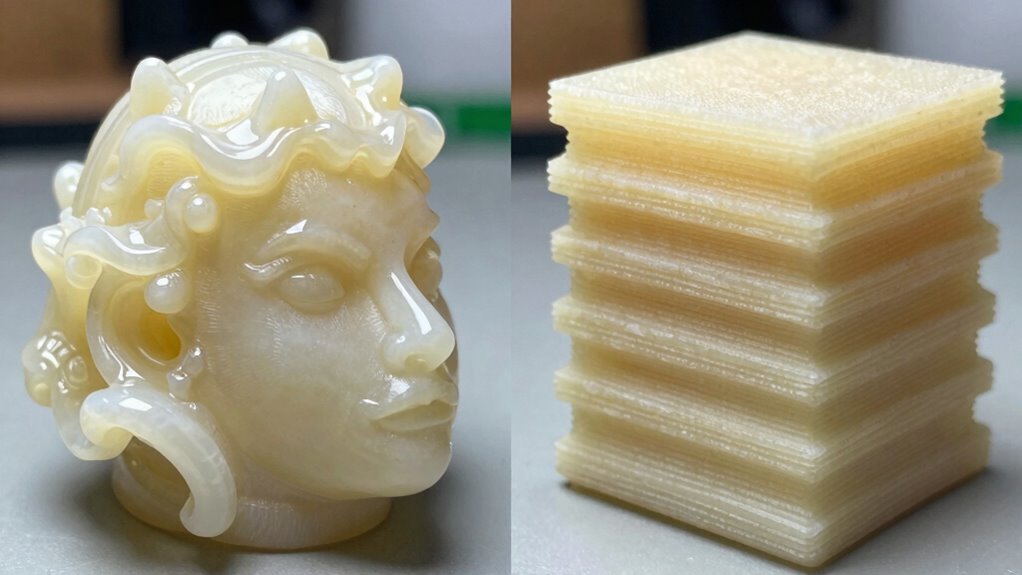

Choosing between resin and FDM 3D printing is more about your business goals than the technology alone. Resin offers high detail, smooth surfaces, and niche market appeal, but comes with higher costs and longer post-processing. FDM is affordable, faster for large volumes, and ideal for durable, functional parts. Consider what aligns best with your priorities—if you want to learn how these differences shape your success, keep exploring your options.
Key Takeaways
- Business strategies depend more on market positioning: high-detail resin for niche, premium products, and FDM for volume and cost efficiency.
- Resin’s higher costs justify its use in specialized, high-quality applications, while FDM favors scalable, large-scale production.
- Resin offers precision and surface finish advantages, appealing to brands prioritizing quality; FDM emphasizes speed and affordability.
- Technological advancements influence long-term suitability, but strategic goals like customization or mass production are decisive.
- The choice reflects overall business priorities—luxury and detail versus volume and cost—beyond just printing technology.
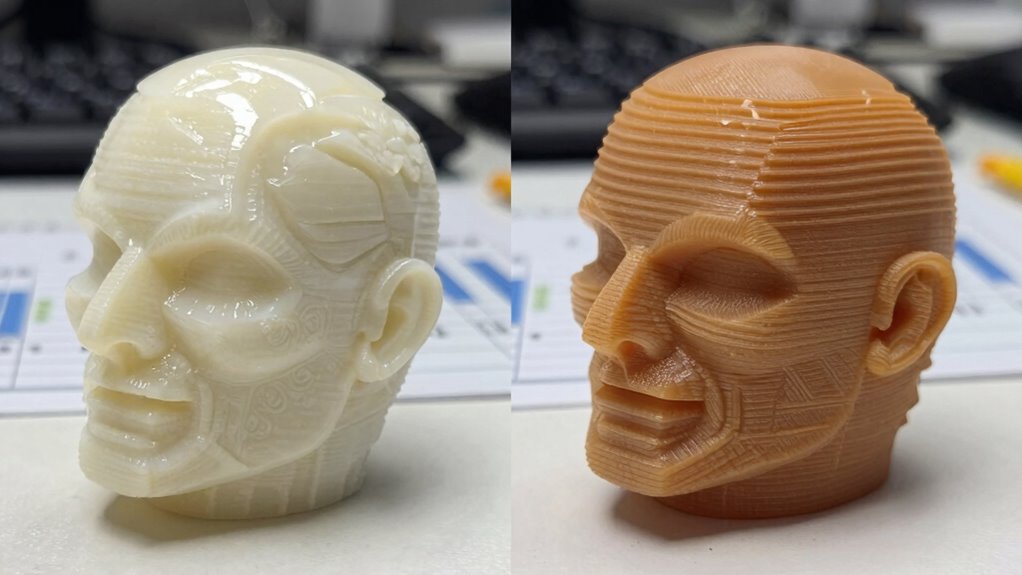
When choosing between resin and FDM 3D printing for your business, understanding their key differences can considerably impact your production efficiency and product quality. These choices aren’t just about the technology but also about how well each method aligns with your company’s goals and market demands. Resin printing, also known as stereolithography, offers high-resolution outputs with intricate details, making it ideal if your products require precision and fine features. FDM (Fused Deposition Modeling), on the other hand, tends to be more versatile and cost-effective for larger, less detailed parts. The decision ultimately influences your market adaptability—how quickly and efficiently you can respond to customer needs—and your cost efficiency, which determines your profit margins.
Choosing between resin and FDM 3D printing impacts quality, cost, and market responsiveness.
Resin printing excels in applications demanding high-quality surfaces and complex geometries. If your business needs detailed prototypes, jewelry, dental models, or intricate artistic pieces, resin’s ability to produce smooth, precise finishes is a game-changer. However, this precision comes with higher material costs and longer post-processing times, which can affect your overall cost efficiency. Resin printers often have higher initial investment costs and require specialized handling, making them less suitable for high-volume production. But if your focus is on creating premium, detailed products, resin provides a competitive edge that can justify the added expense and time. Additionally, advancements in resin materials continue to expand the scope of applications and improve cost-effectiveness over time.
FDM printers are typically more accessible and scalable. They use thermoplastic filaments, which are generally cheaper than resin and easier to handle. This makes FDM a smarter choice if your business prioritizes rapid, large-scale production. It’s easier to set up, maintain, and operate, which translates into lower operational costs and faster turnaround times. This scalability improves your market adaptability, allowing you to meet increasing demand or customize products quickly without significant additional investment. While the surface finish and resolution aren’t as high as resin, FDM’s strength lies in its ability to produce sturdy, functional parts efficiently and economically.
In the end, the bigger business difference between resin and FDM isn’t just about the tech specs; it’s about how each method aligns with your strategic priorities. If your goal is high-detail, niche products with a focus on quality, resin might suit you better despite higher costs. But if you need speed, volume, and lower costs to stay competitive, FDM offers a more adaptable solution. Your choice impacts not only your production process but also your ability to stay flexible and competitive in a dynamic market.

ELEGOO ABS-Like Resin 3.0+, Upgraded 3D Printer Photopolymer Resin, Higher Heat-Resistance Fast Curing High Precision Non-Brittle, Grey 3000g
Higher Heat-Resistance: The 3D printed models with ABS-Like 3.0 Plus maintains its physical shape and mechanical properties at…
As an affiliate, we earn on qualifying purchases.
As an affiliate, we earn on qualifying purchases.
Frequently Asked Questions
How Do Resin and FDM Printers Compare in Maintenance Costs?
You’ll find resin printers generally have higher maintenance costs due to their delicate components and complex cleaning needs, especially with resin material durability. FDM printers tend to be more affordable to maintain because they’re sturdier and easier to clean, with faster print speeds reducing wear and tear. Over time, FDM printers usually offer lower ongoing costs, making them more cost-effective for long-term use, especially if you prioritize quick turnaround.
Which Technology Offers Better Scalability for Large Production Runs?
Picture a conveyor belt stretching endlessly, symbolizing large-scale production. FDM technology offers better scalability for big runs, thanks to its cost efficiency and ability to handle continuous production. You’ll find it more suitable for high-volume output, especially when material flexibility is essential. Resin printers, while excellent for detail, struggle with scaling efficiently. So, if you’re aiming for large production runs, FDM is your best bet.
What Are the Environmental Impacts of Resin Versus FDM Printing?
You should consider the environmental impacts of resin versus FDM printing by focusing on eco-friendly materials and recycling practices. Resin printing often produces more waste and involves chemicals that can be harmful if not disposed of properly. FDM printing, on the other hand, generally uses thermoplastics that can be recycled more easily. By adopting eco-friendly materials and proper recycling, you can minimize your environmental footprint regardless of the technology you choose.
How Do Resin and FDM Printers Differ in Material Waste Management?
Think of resin and FDM printers like two different treasure chests—each with its own way of handling waste. Resin printers generate liquid waste requiring careful disposal or material recycling, often needing curing before disposal. FDM printers produce filament scraps or support material that can often be recycled or reused directly. Your choice impacts how you manage material waste and aligns with your sustainability goals.
Which Technology Is More Suitable for Rapid Prototyping?
You’ll find resin printers more suitable for rapid prototyping because they offer higher print speeds and superior material versatility. Resin printers can produce detailed prototypes quickly, allowing you to iterate faster. While FDM printers are versatile, they usually take longer and may not achieve the same level of detail. If speed and detail are priority, resin technology helps you prototype efficiently and accurately, speeding up your development process.
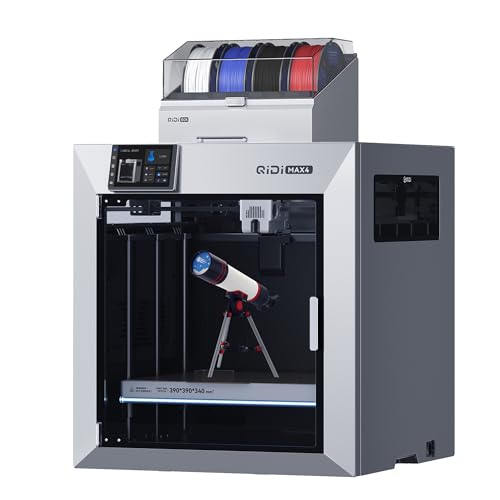
QIDI Max4 Combo 3D Printer, 390×390×340mm Large Build Volume, 65℃ Heated Chamber FDM 3D Printers, Max 800mm/s High Speed, Supports Up to 16-Colors/Multi Materials with QIDI BOX, Auto Bed Leveling
Ultra-Large Build Volume: QIDI Max4 Combo has a 390×390×340mm printing area, 55% larger than its predecessor MAX3, enables…
As an affiliate, we earn on qualifying purchases.
As an affiliate, we earn on qualifying purchases.
Conclusion
In the end, choosing between resin and FDM is like picking the right tool for a job—you need to know your goals. Resin offers precision like a surgeon’s scalpel, perfect for detailed work. FDM is more of a dependable hammer, great for larger, functional parts. Your decision shapes your business’s future, so weigh not just the tech, but the bigger picture—it’s the difference between building castles in the air or solid foundations.
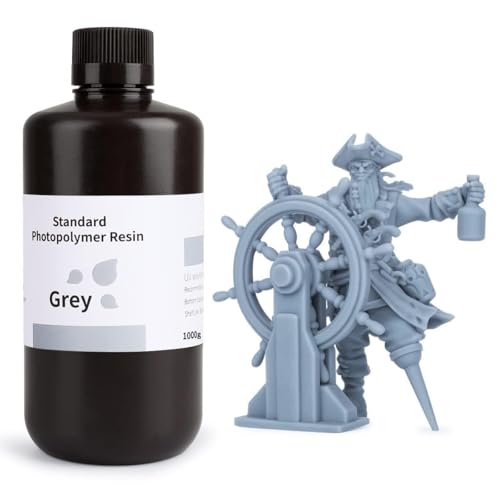
ELEGOO Standard Photopolymer Resin LCD UV-Curing Resin 405nm 3D Printer Resin for Mars Saturn Jupiter MSLA DLP LCD 3D Printing Grey 1000g
【Low Shrinkage and High Precision】ELEGOO photopolymer resin is specially designed for reducing volume shrinkage during the Photocuring process…
As an affiliate, we earn on qualifying purchases.
As an affiliate, we earn on qualifying purchases.

ELEGOO PETG Filament 1.75mm Black 1KG, 3D Printer Filament Dimensional Accuracy +/- 0.02 mm, 1kg Spool(2.2lbs) Fits for Most FDM 3D Printers
TOUGH AND DURABLE: ELEGOO PETG filament combines the best properties of PLA and ABS, offering excellent durability and…
As an affiliate, we earn on qualifying purchases.
As an affiliate, we earn on qualifying purchases.