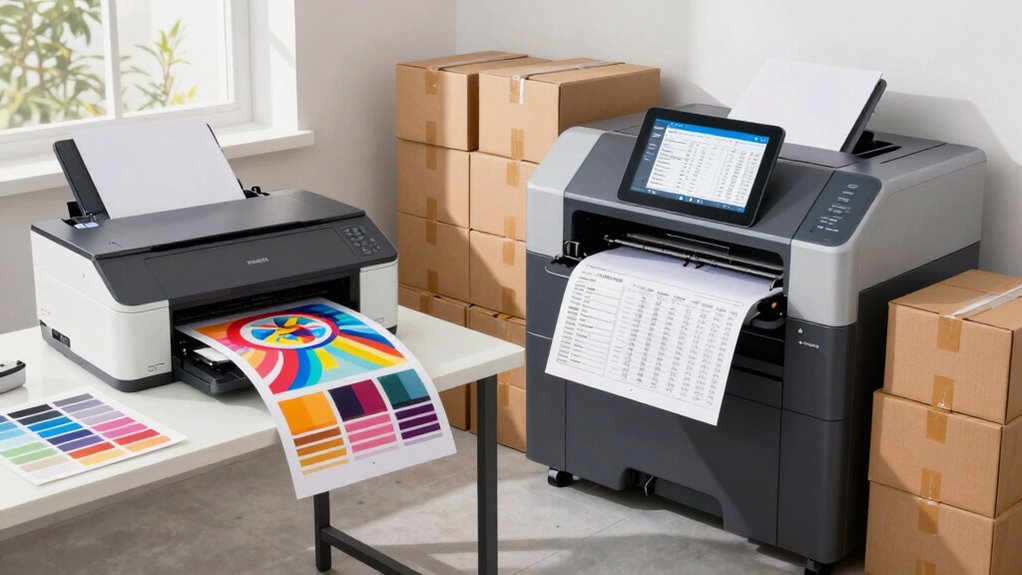

You need different business logic for print-on-demand and in-house printing because they serve unique operational goals. Print-on-demand offers flexibility and low inventory risk, ideal for testing designs and quick adaptation. In contrast, in-house printing provides better control and high-volume efficiency but requires upfront investment and more management. Understanding these differences helps you choose the right approach for your growth. Keep exploring to see how these strategies can best align with your business needs.

Get smart everyday buys delivered free with Prime
- Fast, free delivery on millions of items
- Prime Video, Amazon Music and more included
- Member-only deals all year
Key Takeaways
- They serve different strategic goals: flexibility and customization versus control and high-volume quality.
- Print-on-demand relies on third-party scalability, while in-house printing requires significant infrastructure investment.
- Cost control varies: in-house offers direct expense management; print-on-demand depends on external quality assurance.
- Business logic differs: quick market testing with print-on-demand versus long-term scalable production in-house.
- Operational preferences influence decision-making: minimal inventory risk versus immediate control over production quality.
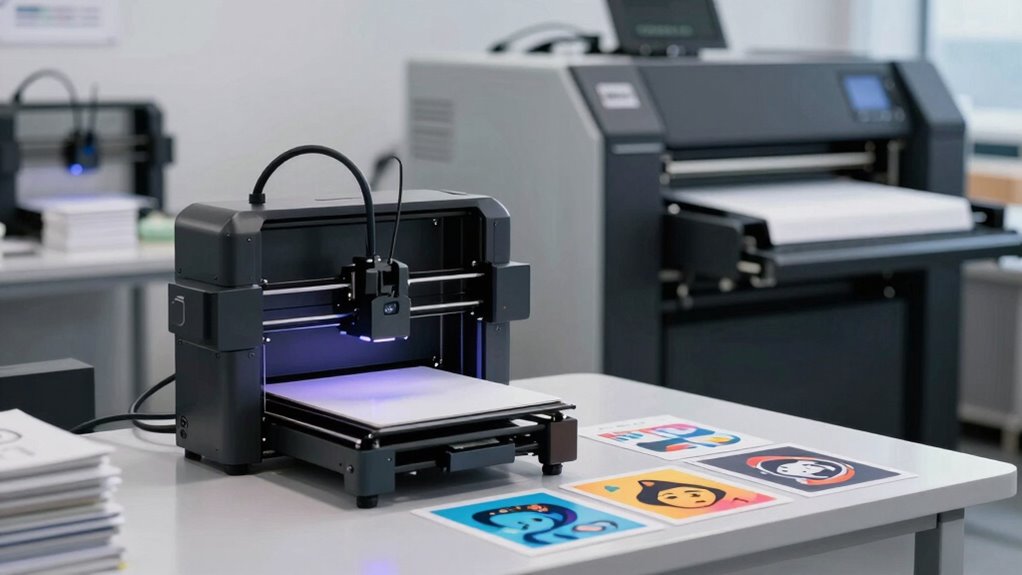
Deciding between print-on-demand and in-house printing depends on your business goals and operational preferences. Both options serve different needs, and understanding their unique business logic is vital to making the right choice. Print-on-demand offers a flexible approach, allowing you to fulfill orders as they come without maintaining large inventories. This model relies heavily on customization options, enabling you to offer a wide range of designs, styles, and products without the risk of unsold stock. You can easily update or expand your product line, tailoring offerings to current trends or customer preferences. However, because each item is produced only after an order is placed, production scalability becomes a key factor. You need to guarantee your print-on-demand provider can handle spikes in demand without sacrificing quality or delivery times. If your business aims to operate with a lean inventory while maintaining a high degree of customization, print-on-demand fits perfectly.
In contrast, in-house printing involves setting up your own production facilities or equipment, giving you direct control over the entire process. This approach often requires significant upfront investment in printers, materials, and staff, but it can be advantageous if you want to streamline production and maintain strict quality standards. With in-house printing, you gain the ability to customize products more intricately and rapidly respond to specific customer requests. You’re not dependent on third-party providers, which means you can also better control costs and profit margins. Additionally, understanding production scalability is crucial for planning long-term growth. However, scaling production is more complex; increasing output means expanding your facilities, training staff, and managing inventory. This business logic makes sense if you plan to produce large quantities regularly, or if your brand relies on unique, high-quality items that benefit from tight quality control.
Ultimately, your choice hinges on your business’s growth trajectory and the level of control you desire. If you want to test multiple designs with minimal risk and adapt quickly to market changes, print-on-demand’s flexibility and focus on customization options are ideal. But if you’re aiming for high-volume, consistent quality, and long-term control over production, in-house printing’s scalability and direct oversight are more suitable. Both models operate under different business logics because they prioritize different aspects of production and flexibility. Recognizing these differences ensures you develop a strategy aligned with your goals, whether that’s rapid iteration or large-scale, high-quality output.
As an affiliate, we earn on qualifying purchases.
Frequently Asked Questions
How Does Order Volume Impact Business Logic Choices?
Order volume directly impacts your business logic choices by influencing how you handle order scalability and customer customization. If your volume is high, automating processes and streamlining workflows become essential to keep up efficiently. For lower volumes, you can focus more on personalized customer customization, which often requires flexible, manual processes. Balancing these factors helps you choose systems that support growth while maintaining quality and customer satisfaction.
What Are the Key Cost Differences Between the Models?
Think of costs as the roots beneath your business tree—deeply influencing growth. Print-on-demand typically has lower upfront costs due to minimal material sourcing and no inventory, but higher per-unit expenses, especially with design customization. In-house printing demands significant investment in materials and equipment, but spreads costs over larger volumes, reducing per-unit costs. Your choice hinges on balancing initial investments against ongoing expenses, shaped by your production scale and customization needs.
How Do Turnaround Times Influence Operational Decisions?
Turnaround times heavily influence your operational decisions because customer expectations demand quick delivery, especially with rapid supply chain changes. Faster turnaround times mean you need streamlined workflows, reliable suppliers, and flexible processes to meet deadlines. You might prioritize in-house printing for speed, while print-on-demand models can handle smaller, more frequent orders efficiently. Balancing these factors helps you satisfy customers and optimize your supply chain, ultimately boosting your business’s agility and reputation.
What Technology Integrations Are Essential for Each Approach?
You need different technology integrations for each approach. For print-on-demand, prioritize platforms that support design customization and seamless online ordering, boosting customer engagement. In-house printing benefits from advanced production management and inventory systems to optimize workflows. Both require robust software, but print-on-demand emphasizes e-commerce and automation tools to enhance customer experience, while in-house setups focus on detailed production tracking and quality control.
How Do Quality Control Processes Differ?
You guarantee quality standards differ by tailoring inspection procedures to each method. In print-on-demand, you focus on quick, automated checks for consistency and color accuracy, often relying on software. In-house printing allows for more detailed inspection procedures, including manual quality assessments, to meet higher standards. You adjust your processes accordingly, emphasizing efficiency for print-on-demand and precision for in-house production to maintain ideal quality control.
in-house custom printing equipment
As an affiliate, we earn on qualifying purchases.
As an affiliate, we earn on qualifying purchases.
Conclusion
Understanding the differences in business logic between print-on-demand and in-house printing is like choosing the right tool for a job—you wouldn’t use a hammer to screw in a bolt. Each approach has unique needs and workflows that demand tailored strategies. By recognizing these distinctions, you can optimize operations, reduce costs, and improve customer satisfaction. Ultimately, aligning your business logic with your printing method guarantees a smoother process, just like a well-oiled machine running seamlessly.
digital textile printers for small business
As an affiliate, we earn on qualifying purchases.
As an affiliate, we earn on qualifying purchases.
high-volume commercial printing press
As an affiliate, we earn on qualifying purchases.
As an affiliate, we earn on qualifying purchases.
Halloween Picks
halloween
As an affiliate, we earn on qualifying purchases.