
TL;DR

Get smart everyday buys delivered free with Prime
- Fast, free delivery on millions of items
- Prime Video, Amazon Music and more included
- Member-only deals all year
IdeaClyst acts as a personal, local-first war room where founders can test, refine, and track ideas with a structured, collaborative process. It combines AI-driven debate, discovery, and a central workspace to turn raw concepts into actionable plans—all on your own device.
Ever stared at three open tabs, each holding a different idea, and felt that sinking feeling? The kind that whispers: ‘This could be the one… or a six-month dead end.’ That’s where a digital war room like IdeaClyst steps in. It’s more than just a tool — it’s a focused, strategic hub designed to help you make tough calls faster and more confidently. Learn more about data-driven marketing strategies.
Imagine having an AI council that doesn’t just agree with your assumptions but challenges them, surfacing blind spots before you pour months into building the wrong thing. Whether you’re a solo founder or leading a small team, understanding how to structure your idea pipeline inside a dedicated war room can save you thousands of dollars and endless frustration. That’s what we’ll explore today: how IdeaClyst turns the chaos of ideas into a clear, actionable strategy.
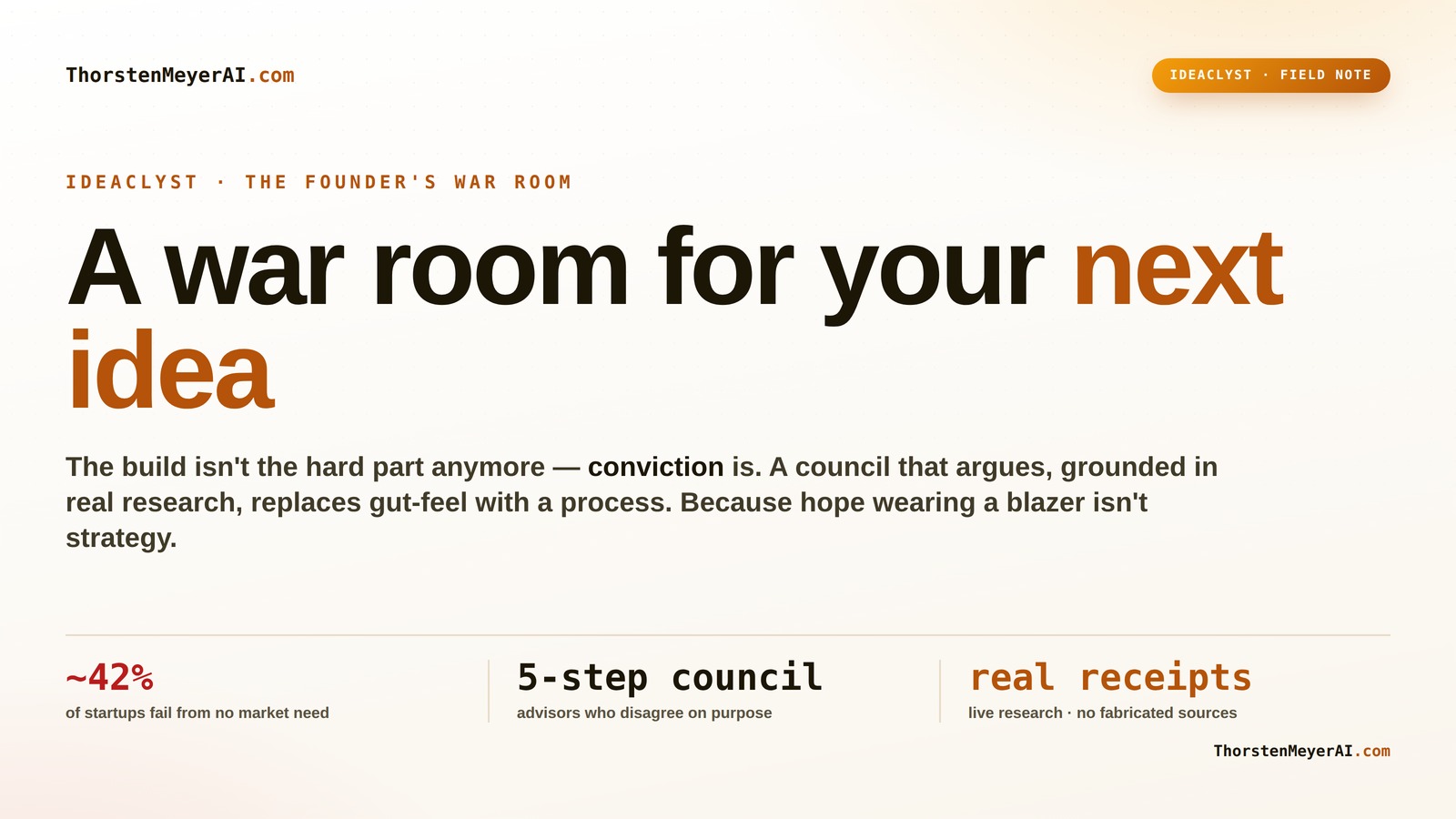
A war room for your next idea
The build isn’t the hard part anymore — conviction is. Knowing which idea deserves the next six months, and being able to defend it. Most founders answer with gut feel and optimistic math. That’s hope wearing a blazer. IdeaClyst replaces it with a process.
The most expensive decision is what to build
The single most valuable thing a tool can do is talk you out of the wrong six months. The numbers make the case better than any pitch.
Three tools in one — on your own machine
Strip away the framing and IdeaClyst is three things at once, all running locally with nothing leaving your laptop.
An AI council
Pressure-tests an idea you bring it — advisors who argue on purpose.
A discovery engine
Finds ideas you didn’t know to look for by hunting real demand signals.
A founder’s workspace
Carries winners from “interesting” all the way to “ready to build.”
Advisors who disagree on purpose
Not one confident, agreeable answer — a structured five-step deliberation where models play different roles and turn on their own work. The disagreement is the feature.
The five-step deliberation
A council that leads with the bad news surfaces the objections you’d otherwise find the expensive way, on month five.
Product strategy
Who’s it for, what’s the wedge, why now, what’s the business model.
Technical architecture
What would it actually take to build — and where’s the risk.
Critique pass
The council turns on its own work. Where’s the hand-waving? What kills this?
Second, independent critique
A different voice, a different angle — so blind spots don’t survive.
Final synthesis
Everything into one coherent founder packet: strategy, architecture, validation, plan.
When IdeaClyst cites a source, it actually fetched it
The hard departure from “ask an AI what it thinks of my startup.” It runs in a strict, real-data-only mode — if it can’t gather genuine evidence, it says so plainly rather than inventing a plausible paragraph.
Confidence with receipts
No fabricated statistics, no imaginary competitors, no made-up citations. The packet survives a skeptical co-founder or a sharp investor because the reasoning has receipts.
Market research first
Scouts the landscape before the council reasons about anything.
Competitor read
Real positioning, pricing signals, feature claims — differentiation vs. reality.
Validation with links
Not “talk to customers” — concrete signals & sources you can click.
From the blank page to build-ready
Evaluation is half the problem; the blank page is the other half. And a plan is worthless if it dies in a tab you never reopen.
Bring a space, not an idea
“AI for accountants,” “tools for indie game studios” — plus your goal and real capacity. It hunts demand signals across HN, Reddit, Product Hunt, GitHub, pricing pages.
- An honest market read — leads with the bad news when a space is hard
- An opportunity map — high pain, thin competition
- Ranked candidates — wedge, who pays, effort, risk, confidence
- each with KILL CRITERIA — when to walk away
A home and a forward path
Every promising idea gets carried forward, with every artifact in plain files on your disk.
- Validation tooling — sprint board, interview list, evidence browser
- Founder profile — a personal-fit lens; same discovery, different advice
- Build workspaces — funnel, personas, landing draft, version history
- “Build this idea” → a PRD + task queue, ready for a coding agent
Key Takeaways
- A digital war room centralizes idea management, making it easier to visualize, challenge, and decide on the best next steps.
- IdeaClyst’s structured AI council stages debates, surfacing risks and blind spots before costly development.
- Grounding ideas in real-time research dramatically reduces the risk of building something the market doesn’t want.
- Regular rituals keep your war room active and valuable—don’t treat it as a one-off project.
- Unlike simple idea tools, IdeaClyst combines debate, validation, and documentation into a single, private, local-first platform.
As an affiliate, we earn on qualifying purchases.
What Is a Digital War Room and Why Should You Care?
A digital war room is your central command center for ideas, decisions, and progress. It’s where your team gathers—virtually—to focus on what’s important, track progress, and challenge assumptions. Think of it as a living, breathing map of your innovation journey.
For a founder, this means never losing sight of a promising idea or getting bogged down in endless debates. Instead, you have a structured space that keeps everyone on the same page, with a clear view of what’s next. It’s like having a battle plan, but for your startup’s growth.
Recent trends show that most teams now favor digital over physical war rooms, especially as remote work becomes the norm. You can explore more about virtual war rooms. You can set up a virtual board, organize workflows, and keep everything accessible—no clutter, no lost sticky notes. This makes a digital war room highly adaptable, portable, and always ready to pivot.
As an affiliate, we earn on qualifying purchases.
How IdeaClyst Turns Your Idea Into a Structured Battle Plan
IdeaClyst isn’t just a note-taking app. It’s a structured process wrapped in AI power. When you bring an idea—be it a sentence or a vague concept—it quickly transforms into a comprehensive debate among multiple AI ‘advisors.’ These advisors play different roles: one challenges your strategy, another examines technical risks, and a third critiques assumptions.
Here’s how it works step-by-step:
- You submit your raw idea.
- The AI council stages a five-step debate: strategy, architecture, critique, independent review, and synthesis.
- The council produces a detailed founder’s packet in Markdown, with clear sections on each topic, including research, risks, and next steps.
- You get a ready-to-share, version-controlled document—your battle plan to make data-driven decisions.
This process ensures you don’t fall into the trap of blind optimism or wishful thinking. Instead, you get a balanced, well-argued case for or against your idea, grounded in real research, not just model vibes.
As an affiliate, we earn on qualifying purchases.
The AI Council: Why Disagreements Make Your Idea Stronger
The magic of IdeaClyst lies in its AI council—five models playing different roles, intentionally disagreeing to surface flaws. Think of it as a panel of experts, each with a different lens: market, tech, risks, validation, and strategy.
These disagreements aren’t just noise—they are deliberate and valuable. When each model presents a different perspective, it creates a richer, more nuanced view of your idea’s strengths and weaknesses. For example, the strategy advisor might highlight a lucrative market opportunity, while the technical advisor might warn about complexity or costs. These contrasting views force you to confront assumptions, identify blind spots, and refine your approach.
Research in decision-making shows that diverse perspectives and constructive disagreement lead to better outcomes. By intentionally fostering this debate, IdeaClyst helps you develop ideas that are more resilient and better vetted, reducing the risk of costly failures. Documenting these disagreements into a clear plan ensures you address potential issues before moving forward, making your decision process more thorough and balanced.
As an affiliate, we earn on qualifying purchases.
Why Grounding Ideas in Real Research Matters (and How IdeaClyst Nails It)
Many AI tools excel at generating ideas but fall short on validation. That’s a big mistake, because ideas ungrounded in real-world data can lead to costly pivots or failures. IdeaClyst’s secret weapon is its ability to anchor every debate and analysis in live web research, ensuring that your ideas are rooted in current, relevant data.
This grounding isn’t just about adding facts—it fundamentally shifts the decision-making process. Discover how fintech insights and payment processing can support your strategy. When you see real-time data, recent market trends, or competitive insights, you can distinguish between hype and reality. For insights on cryptocurrency and market data. For example, instead of a vague claim like ‘the market is growing,’ IdeaClyst pulls recent data showing a 15% annual growth rate in your target niche, or recent customer feedback that validates demand. This evidence-based approach helps you prioritize ideas with the highest potential and avoid pursuing dead-end concepts.
Research supports this approach: startups that incorporate real data into their validation process are 50% less likely to fail due to misjudged market fit or technical feasibility. By continuously integrating live data, IdeaClyst ensures your decisions are based on facts, reducing guesswork and increasing confidence in your strategy.
Transforming Raw Ideas into Actionable Plans — Your New Workflow
Most founders struggle to turn a vague idea into a clear next step. IdeaClyst streamlines this process into a simple workflow: Learn more about payment operations and fraud prevention strategies.
- Capture raw idea in the system.
- Run it through the AI council for debate and critique.
- Refine based on feedback and research.
- Generate a final plan — ready to build, test, or pitch.
This workflow doesn’t just make the process easier—it reduces the cognitive load and minimizes overlooked details. For more on effective lifestyle and personal finance tips. When a founder starts with an idea like, ‘Build a new onboarding flow,’ the AI council digs into critical questions: Who are the users? What’s the core value proposition? What technical risks exist? The system then produces a detailed, research-backed plan with clear next steps and risk assessments. This structured approach ensures no critical aspect is missed, enabling swift, confident progression from idea to execution. It also facilitates iteration—refining ideas based on new data or insights without starting from scratch—saving time and reducing costly mistakes.
Keeping Your War Room Alive — Rituals and Tips
A war room only works if it’s kept active and engaged. Regular rituals reinforce its value and ensure continuous improvement. Scheduling weekly or bi-weekly review sessions allows your team to revisit ongoing ideas, challenge assumptions, and incorporate fresh research. This consistency prevents stagnation and keeps the process dynamic.
Practical tips include maintaining a living document—frequently updating research, refining plans, and tracking changes—so the war room evolves with your project. Using visual cues like color-coded status tags or priority labels helps team members quickly grasp the current state of each idea, fostering transparency and accountability.
Another critical aspect is fostering a culture of open critique and diverse perspectives. Encouraging team members or advisors to regularly contribute, question, and challenge ensures the war room remains a fertile ground for innovation and critical thinking. Ultimately, the more you treat your war room as a strategic nerve center—integrating it into your daily routines—the more it becomes a catalyst for smarter, faster decision-making and a competitive advantage.
What Makes IdeaClyst Different From Ordinary Idea Tools?
Most idea management tools are just digital sticky notes—easy to use but lacking depth. IdeaClyst combines structured debate, real-time research, and a local-first design that keeps your data private and under your control.
It’s like having a strategic command center that evolves with your project, rather than a static list of ideas. Its emphasis on disagreement, grounded validation, and comprehensive documentation sets it apart from simple brainstorming apps.
While tools like Trello or Notion help organize ideas, they often lack mechanisms for critical analysis or validation. IdeaClyst’s AI council actively challenges and refines ideas, transforming raw concepts into well-vetted, actionable plans. This layered approach ensures that your ideas aren’t just stored—they’re rigorously tested and validated before moving forward, saving time and reducing costly missteps.
How to Build Your Own Digital War Room — Quick Tips
If you’re ready to create your own war room, here are quick tips:
- Use a collaborative platform like Notion, Obsidian, or your own local setup.
- Organize ideas into stages: raw idea, critique, refinement, plan.
- Schedule regular review sessions to keep it active.
- Incorporate data sources—web scraping, APIs, or research reports—to ground discussions.
- Encourage diverse perspectives—get team members or advisors involved.
By following these steps, you create a structured environment that promotes critical thinking, continuous refinement, and informed decision-making—key ingredients for successful innovation. The process of setting up and maintaining such a space encourages discipline and strategic focus, which are often overlooked but vital for turning ideas into reality efficiently and confidently.
Frequently Asked Questions
What is a digital war room and why do I need one?
A digital war room is your central hub for managing, debating, and refining ideas. It helps keep your team aligned, surfaces risks early, and accelerates decision-making—crucial for avoiding costly missteps in startup growth.
Can I build a war room without fancy tools?
Absolutely. The core is structure and discipline. You can use simple tools like Notion, Obsidian, or even markdown files on your local machine. The key is consistent updates and regular review sessions to keep ideas alive and actionable.
How does IdeaClyst improve idea validation?
IdeaClyst grounds every debate in live web research, pulling fresh data to support or dismiss assumptions. This reduces guesswork, making your validation process faster, cheaper, and more reliable than traditional methods.
Is a war room suitable for remote teams?
Yes. Digital war rooms are especially well-suited for remote or hybrid teams because they centralize information and facilitate asynchronous collaboration, keeping everyone aligned regardless of location.
What’s the biggest mistake to avoid in setting up a war room?
Turning it into a decoration—something you set up once and forget. A war room must be active, updated, and used regularly to be effective. It’s a living tool, not just a display board.
Conclusion
Your next big idea deserves a strategic home base—a place where debate, validation, and planning happen in one focused space. IdeaClyst turns that vision into reality, giving founders the confidence to build faster and smarter.
Think of it as your personal command center for innovation. The real power isn’t just in capturing ideas — it’s in actively shaping and challenging them with data, disagreement, and clarity. That’s how great startups are born: inside a war room that pushes you to be better every day.
Halloween Picks
halloween
As an affiliate, we earn on qualifying purchases.