
Among these financial literacy books for teens, my best overall pick is Financial Literacy for Teens Unlocked for its broad mix of budgeting, saving, and investing. For teens who learn best by doing, the Financial Literacy Workbook for Teens Ages 14–18 offers practical exercises, while The Motley Fool Investment Guide for Teens makes investing its clear focus. The main tradeoff is between a broad introduction and a workbook or specialist title that gives one skill more attention. Age range, reading style, and how much guidance a teen needs can matter as much as the topics covered. Continue reading for the full breakdown and help matching a book to the learner.

Get smart everyday buys delivered free with Prime
- Fast, free delivery on millions of items
- Prime Video, Amazon Music and more included
- Member-only deals all year
Key Takeaways
- Financial Literacy for Teens Unlocked is the broadest starting point among the named general guides, while The Motley Fool Investment Guide for Teens is the more targeted choice for investing.
- The workbooks differ in audience and scope: the Ages 14–18 workbook names credit alongside core money skills, while the Ages 13–17 workbook emphasizes modern money skills and traps.
- Humble Math – Money and Financial Literacy covers consumer math alongside banking, loans, investing, and business basics, making it a better fit for learners who want money concepts tied to numbers.
- Younger readers have more age-specific choices, including Evan-Moor for ages 12–13 and Money Skills for Kids for tweens; a teen label alone does not guarantee an appropriate reading level.
- The lineup spans step-by-step guides, hands-on workbooks, and visual reference material, so the best match depends on whether the teen learns by reading, practicing, or scanning visuals.


| financial literacy books for teen | Topics | Format | ASIN | Audience |
|---|---|---|---|---|
| Financial Literacy for Teens U | Budgeting, saving, and investing | Book | — | Teens |
| Financial Literacy Workbook fo | Budgeting, saving, investing, credit building, and money management | Workbook | — | Teens ages 14–18 |
| Financial Literacy for Teens a | Budgeting, saving, and investing | Guide | — | Teens and young adults |
| Money Skills and Personal Fina | Budgeting, saving, and investing | Guide | — | Teenagers |
| Financial Literacy for Young A | Managing, saving, and investing money | Guide | — | Young adults |
| 35 Money Skills Workbook for T | Budgeting, wealth building, saving strategies | Workbook | 1964831121 | — |
| Humble Math | Banking, investing, loans, business basics | — | 1635783933 | — |
| The Motley Fool Investment Gui | — | Not specified in supplied product data | 0743229967 | Teens |
| Financial Literacy Workbook fo | Money skills, buy now pay later, sports betting and gambling apps, payment app scams | Workbook | B0HHXYWTQJ | — |
| Financial Literacy For Teens I | Budgeting, saving, credit building, debt avoidance, introductory investing | Guide | B0HP7GDGSK | Teens |
| Evan-Moor Financial Literacy a | Budgeting, saving, spending, and using credit | — | 1645144240 | — |
| First to a Million: A Teenager | — | — | 1947200461 | — |
| Personal Finance for Teenagers | Earning, saving, and investing | Book | 196450404X | Teenagers |
| Money Skills for Kids: A Begin | Earning, saving, budgeting, and spending wisely | — | B0CGTQ5W5B | Tweens, teens, and young adults |
| The Infographic Guide to Perso | — | — | 1507204663 | — |
More Details on Our Top Picks
Financial Literacy for Teens Unlocked: A Guide to Budgeting, Saving, and Investing
I rank this as the best all-around starting point because it covers budgeting, saving, and investing in one guide aimed specifically at teens. That combination can help readers connect everyday spending choices with longer-term goals, rather than treating each money topic separately. Compared with Financial Literacy Workbook for Teens Ages 14–18, this title is described as a guide rather than an activity-based workbook, so it may suit teens who prefer reading explanations to completing exercises. Its stated focus on financial independence gives the topics a useful shared purpose. The tradeoff is that the available details do not say how long the book is, how topics are taught, or whether it includes examples and activities. Readers seeking a defined age range or hands-on practice may prefer the workbook instead.
Pros:- Covers budgeting, saving, and investing in one guide.
- Specifically intended for teen readers.
- Connects money skills with financial independence.
Cons:- The provided information does not specify length or detailed format.
- No activities or practice exercises are described.
- The level of depth for each topic is unclear.
Best for: Teens who want one introductory guide to budgeting, saving, and investing, especially readers motivated by building financial independence.
Not ideal for: Teens who need structured exercises, a specified age range, or detailed information about the book’s length and teaching format.
- Format:Book
- Audience:Teens
- Topics:Budgeting, saving, and investing
- Stated focus:Building financial skills and independence
- Book length:Not specified in provided product data
- Activities:Not specified in provided product data
Our verdict“Choose this guide if a teen wants a broad introduction to core money topics, but choose the workbook for clearly described hands-on practice.”
Financial Literacy Workbook for Teens Ages 14–18: Practical Guide to Budgeting, Saving, Investing, Credit Building, and Smart Money Management
This is my pick for active learners ages 14–18: it pairs explanations with real-life activities, giving teens a way to apply money concepts rather than only read about them. Its coverage also reaches credit building, a practical addition not listed for Financial Literacy for Teens Unlocked, alongside budgeting, saving, and investing. That wider range makes it better suited to high school students preparing for adult financial choices. The age band is also unusually clear, which helps families match the book to a reader. The tradeoff is that the stated audience may feel narrow for younger teens or readers beyond high school, and the supplied details do not identify the number or type of activities. Teens who want a general guide without workbook-style tasks may prefer Money Skills and Personal Finance for Teens Made Easy.
Pros:- Includes real-life activities to reinforce money concepts.
- Covers budgeting, saving, investing, and credit building.
- Names a specific audience of teens ages 14–18.
- Connects explanations with practical money management.
Cons:- The stated age range may not fit younger readers or young adults.
- The provided information does not describe the activities in detail.
- Book format and length are not specified in the supplied data.
Best for: High school students ages 14–18 who learn best by completing practical activities and want an introduction that includes credit building.
Not ideal for: Readers younger than 14 or older than 18, and teens who prefer a straightforward reading guide over workbook activities.
- Format:Workbook
- Audience:Teens ages 14–18
- Topics:Budgeting, saving, investing, credit building, and money management
- Learning approach:Explanations paired with real-life activities
- Intended use:Develop practical financial skills before adulthood
- Book length:Not specified in provided product data
Our verdict“Pick this workbook for a high school teen who wants applied practice and credit basics; choose a general guide if activities are not a priority.”
Financial Literacy for Teens and Young Adults 101: A Guide to Budgeting, Saving, and Investing
The clearest distinction here is its teen-and-young-adult audience. I’d place it with readers who want a money guide that can remain relevant as they move beyond high school, rather than one explicitly limited to ages 14–18 like Financial Literacy Workbook for Teens Ages 14–18. It covers the familiar foundation of budgeting, saving, and investing and frames those skills around building financial knowledge and wealth early. That broad audience is useful for older teens, but it also makes the level less precise: the description does not say how explanations or examples change for different ages. Unlike the workbook, no hands-on activities or credit-building coverage are specified. Teens who want a clearly step-by-step approach may find Money Skills and Personal Finance for Teens Made Easy a more targeted alternative.
Pros:- Addresses both teens and young adults.
- Covers budgeting, saving, and investing.
- Emphasizes building financial knowledge early.
- Frames money skills around long-term wealth building.
Cons:- The broad audience leaves the reading level and age fit unclear.
- No activities or workbook exercises are specified.
- Credit building is not included in the provided topic list.
Best for: Older teens and young adults who want an introductory guide to budgeting, saving, and investing that is not described as teen-only.
Not ideal for: Younger teens who need age-specific examples or readers looking for documented exercises, credit guidance, or step-by-step instruction.
- Format:Guide
- Audience:Teens and young adults
- Topics:Budgeting, saving, and investing
- Stated focus:Building financial knowledge and wealth from an early age
- Activities:Not specified in provided product data
- Book length:Not specified in provided product data
Our verdict“Choose this for an older teen or young adult seeking core money topics across an age transition, not for a reader who needs a defined lesson structure.”
Money Skills and Personal Finance for Teens Made Easy: Your Step-by-Step Guide to Budgeting, Saving and Investing
For a teen who needs a clear starting sequence, this title earns my best-for-beginners spot. Its stated step-by-step format promises actionable guidance through budgeting, saving, and investing, making it a more direct fit for readers who want instructions rather than a broad overview. Compared with Financial Literacy for Teens and Young Adults 101, it is explicitly teen-focused and emphasizes accessible fundamentals instead of a wider age span. The limitation follows from that beginner orientation: the description itself says it may be too basic for readers seeking advanced investment strategies. It also does not specify activities, credit topics, or how the steps are organized. Teens who want practice built into their learning may get more from Financial Literacy Workbook for Teens Ages 14–18.
Pros:- Uses a stated step-by-step approach to core money topics.
- Designed specifically for teenagers.
- Covers budgeting, saving, and investing fundamentals.
- Aims to build healthy money habits early.
Cons:- May be too basic for readers seeking advanced investment strategies.
- The supplied description does not specify practice activities.
- Credit building is not listed among its topics.
Best for: Teen beginners who want approachable, step-by-step guidance on budgeting, saving, and introductory investing.
Not ideal for: Teens already comfortable with personal finance who want advanced investing material, credit-building coverage, or clearly described exercises.
- Format:Guide
- Audience:Teenagers
- Topics:Budgeting, saving, and investing
- Approach:Step-by-step instruction
- Stated level:Fundamentals
- Book length:Not specified in provided product data
Our verdict“Choose this as a first finance guide for a teen who wants clear steps, but opt for the workbook if practice activities matter more.”
Financial Literacy for Young Adults Simplified: Manage, Save, and Invest Money
This guide is aimed at young adults, making it the best fit in this group for older teens who want material framed around greater independence rather than a teen-specific lesson plan. Its stated focus on managing, saving, and investing money overlaps with Financial Literacy for Teens and Young Adults 101, but the available description is more compact in scope: it does not mention budgeting by name, credit building, or activities. That makes it a plausible choice for readers seeking a simplified introduction, while leaving fewer clues about how much practical instruction it offers. Compared with Financial Literacy for Teens Unlocked, it is less clearly pitched to teen readers. The main tradeoff is audience fit: families shopping for a younger teen may prefer a book explicitly written for teenagers.
Pros:- Targets young adults preparing for greater financial independence.
- Covers managing, saving, and investing money.
- Describes its approach as simplified.
- Focuses on financial skills for a more secure future.
Cons:- The stated audience may be less suitable for younger teens.
- Budgeting is not explicitly listed in the supplied description.
- Activities, credit topics, and teaching structure are not specified.
Best for: Older teens approaching adulthood and young adults who want a simplified introduction to managing, saving, and investing money.
Not ideal for: Younger teens who need an explicitly teen-focused guide, or readers looking for specified budgeting lessons, credit coverage, or hands-on activities.
- Format:Guide
- Audience:Young adults
- Topics:Managing, saving, and investing money
- Stated approach:Simplified introduction
- Stated focus:Financial skills for a secure and independent future
- Book length:Not specified in provided product data
Our verdict“Pick this for an older teen or young adult who wants a simplified money introduction, but choose a teen-focused guide for younger readers.”
35 Money Skills Workbook for Teenagers Ages 15-19
I’d pick this workbook for a teen who learns money concepts more readily by doing than by reading explanations. Its 35 activities focus on budgeting, saving, and wealth building, giving readers repeated opportunities to work with core ideas rather than just encounter them once. The stated ages 15–19 also make it a closer fit for high-school students than Humble Math – Money and Financial Literacy, which starts at age 12 and covers a wider introductory range. The tradeoff is that the description gives no detail about activity types or how deeply wealth building is treated, so I wouldn’t choose it for advanced investing instruction. Compared with Financial Literacy For Teens In Just 15 Minutes a Day, this is the more practice-led option, but its challenge-based format may feel less suitable to teens who prefer short, guided lessons.
Pros:- Includes 35 activities that give teens chances to apply money concepts.
- Covers budgeting, saving habits, and wealth building.
- Designed for ages 15–19, a focused fit for high-school readers.
Cons:- The available description does not specify the activity formats or difficulty level.
- May be too basic for readers seeking advanced finance material.
Best for: High-school teens ages 15–19 who want structured activities to practice budgeting and saving concepts.
Not ideal for: Older teens seeking advanced investing or detailed wealth-building strategies, since the supplied description positions the material as foundational.
- Format:Workbook
- Activities:35
- Intended age range:15–19
- Topics:Budgeting, wealth building, saving strategies
- Learning approach:Challenge-based activities
- ASIN:1964831121
Our verdict“Choose this workbook for a high-school teen who wants hands-on practice with foundational money skills rather than advanced finance lessons.”
Humble Math – Money and Financial Literacy (U.S. Edition): Consumer Math (Ages 12+) Personal Finance for Kids and Young Adults – Banking, Investing, Loans, Business Basics
For families wanting one starting point across several everyday money subjects, I’d put Humble Math – Money and Financial Literacy ahead of narrower workbooks. The stated coverage spans banking, investing, loans, and business basics, with practical examples and activities intended to reinforce the material. Its age range of 12+ can suit a younger teen beginning consumer math, though that breadth also means older readers may find the treatment introductory. Compared with the 35 Money Skills Workbook for Teenagers Ages 15-19, Humble Math starts younger and names more distinct finance areas, while the other workbook emphasizes repeated activities around budgeting, saving, and wealth building. I’d choose this for an early introduction, not as a final guide to complex investing or debt decisions.
Pros:- Covers banking, investing, loans, and basic business principles.
- Age guidance of 12+ makes it usable for younger teens as well as older readers.
- Practical examples and activities can help connect concepts to everyday money situations.
Cons:- The broad introductory scope may not provide much depth on individual topics.
- May feel too elementary for older teens seeking advanced financial strategies.
Best for: Parents or educators looking for an introductory personal-finance resource for readers ages 12 and up, especially those new to banking and loans.
Not ideal for: Older teens who already understand basic consumer finance and want detailed investing strategies or advanced planning.
- Edition:U.S. Edition
- Subject:Consumer math and personal finance
- Intended age:12+
- Topics:Banking, investing, loans, business basics
- Learning elements:Practical examples and activities
- ASIN:1635783933
Our verdict“Choose Humble Math for a broad first introduction to consumer finance, especially for a younger teen who is not ready for a narrower advanced guide.”
The Motley Fool Investment Guide for Teens: 8 Steps to Having More Money Than Your Parents Ever Dreamed Of
I’d shortlist this title for a teen whose main question is how investing works, rather than how to manage every part of a monthly budget. The supplied description frames it around eight steps for learning about investing and building financial knowledge, giving it a more investment-centered angle than Financial Literacy For Teens In Just 15 Minutes a Day, which also covers budgeting, saving, credit, and debt. That specialization can help a motivated reader focus, but the available product information doesn’t describe the steps, format, or other personal-finance topics. I wouldn’t treat the title’s ambitious promise as evidence of a particular outcome. Compared with the broad coverage of Humble Math – Money and Financial Literacy, this is the more targeted choice, but buyers have less detail here to judge its depth or suitability for a complete beginner.
Pros:- Centers its stated approach on learning about investing.
- Organizes the guide around eight steps, which may give a focused reader a clear sequence.
- A more specialized alternative to broad introductory books such as Humble Math – Money and Financial Literacy.
Cons:- The supplied product information does not describe the eight steps or the depth of instruction.
- Coverage of budgeting, saving, credit, and other core topics is not specified.
- The description provides no format or activity details to help buyers judge the learning experience.
Best for: Teens who are specifically curious about investing and want a guide organized around a defined sequence of steps.
Not ideal for: Readers or parents seeking clearly documented coverage of budgeting, credit, debt, or hands-on activities; those details are not supplied.
- Audience:Teens
- Stated focus:Investing and financial knowledge
- Organization:Eight steps
- Format:Not specified in supplied product data
- Additional topics:Not specified in supplied product data
- ASIN:0743229967
Our verdict“Choose this for an investment-curious teen, but pick a broader, better-documented guide if the goal is a full personal-finance foundation.”
Financial Literacy Workbook for Teens Ages 13–17: Modern Money Skills and Traps
This workbook earns a distinct place for addressing money risks teens may meet through apps and online services, not just familiar topics such as saving and budgeting. Its listed subjects include buy now, pay later services, sports betting and gambling apps, and payment app scams, making it the most explicitly risk-focused pick here. Compared with 35 Money Skills Workbook for Teenagers Ages 15-19, which highlights challenge-based practice in broad money skills, this one points more directly to contemporary traps. The age range of 13–17 also suits younger teens than that workbook. The limitation is that the product data doesn’t state its length or describe specific exercises, so I can’t tell how much guidance accompanies each topic. I’d use it for focused conversations about digital money hazards, not assume it replaces a broad personal-finance course.
Pros:- Addresses buy now, pay later services and their potential pitfalls.
- Names sports betting and gambling apps as topics.
- Covers payment app scams, a relevant digital safety concern for teens.
- Specifies an age range of 13–17.
Cons:- The supplied description does not give the workbook length.
- Specific exercises and teaching methods are not described.
- The listed topics do not establish how much coverage it gives to foundational subjects such as budgeting or investing.
Best for: Parents and educators seeking a resource for ages 13–17 that brings payment apps, buy now, pay later, and gambling risks into money lessons.
Not ideal for: Teens who need a clearly outlined, broad curriculum in budgeting, saving, investing, and credit, since the available topic list emphasizes modern risks.
- Format:Workbook
- Intended age range:13–17
- Series:The Teen Survival Series
- Topics:Money skills, buy now pay later, sports betting and gambling apps, payment app scams
- Length:Not specified in supplied product data
- ASIN:B0HHXYWTQJ
Our verdict“Choose this workbook to discuss modern digital money risks with teens ages 13–17, and pair it with a broader guide if they also need core finance skills.”
Financial Literacy For Teens In Just 15 Minutes a Day: Learn to Budget, Save, Build Credit, Avoid Debt and Start Investing with Confidence
I’d favor this guide for a busy teen who is more likely to keep up with brief, regular lessons than tackle a large workbook in one sitting. Its 15-minutes-a-day approach is paired with a wide subject list: budgeting, saving, credit building, debt avoidance, and introductory investing. That makes it broader than The Motley Fool Investment Guide for Teens, whose supplied description centers on investing, and less activity-led than the 35 Money Skills Workbook for Teenagers Ages 15-19. The tradeoff is depth: short lessons may make the material approachable, but the product description itself notes that the format can limit detail. I’d choose it as a practical overview for a teen building several core habits, not as the sole resource for a complicated credit or investment decision.
Pros:- A 15-minute daily structure can fit around school and other commitments.
- Covers budgeting and saving alongside credit, debt, and introductory investing.
- Teen-friendly language is intended to support confidence with money topics.
Cons:- The concise format may limit depth on each subject.
- The supplied description does not specify the number of lessons or provide examples of activities.
Best for: Busy teens who want a straightforward daily routine covering budgeting, saving, credit, debt, and introductory investing.
Not ideal for: Readers seeking extended exercises or detailed instruction on a single topic, since the short-lesson format may limit depth.
- Format:Guide
- Lesson structure:15 minutes a day
- Audience:Teens
- Topics:Budgeting, saving, credit building, debt avoidance, introductory investing
- Writing style:Easy-to-understand, teen-friendly language
- ASIN:B0HP7GDGSK
Our verdict“Choose this for a teen who wants a brief daily introduction across several personal-finance topics rather than an in-depth workbook.”
Evan-Moor Financial Literacy and Life Skills Workbook for Ages 12–13
I’d choose this workbook for a younger teen who learns money skills best by doing rather than reading a long explanation. Its real-world activities cover budgeting, saving, spending, and credit, giving families a practical starting point for conversations about everyday decisions. The ages 12–13 focus makes it a closer fit for middle-school learners than Financial Literacy Workbook for Teens Ages 14–18, which is aimed at older teens. That focused age range is also a limitation: teens beyond it may want a wider set of scenarios or more advanced material. The product details describe topics and activity style, but not the number or format of exercises, so I wouldn’t choose it expecting a particular lesson plan. It stands out for structured practice, not for deep coverage of investing or financial independence.
Pros:- Covers budgeting, saving, spending, and using credit
- Uses real-world activities to connect concepts with practical decisions
- Designed for a clearly defined 12–13 age range
Cons:- The described topics do not include investing or broader wealth-building strategies
- Activity count and format are not specified, making it hard to judge the depth of practice
- Its narrow age range may make it a short-lived fit for older teens
Best for: Families or educators seeking age-targeted, hands-on money lessons for 12- and 13-year-olds
Not ideal for: Older teens looking for advanced investing, credit-building, or financial-independence guidance
- Brand:Evan-Moor
- Age range:12–13 years
- Product type:Workbook
- Topics:Budgeting, saving, spending, and using credit
- Activity type:Real-world activities
- ASIN:1645144240
Our verdict“Choose this for guided, practical money exercises with a 12- or 13-year-old; pick an older-teen workbook for more advanced material.”
First to a Million: A Teenager’s Guide to Achieving Early Financial Independence
Among these choices, I’d put First to a Million in front of teens who already understand basic budgeting and want a bigger goal: building wealth and pursuing financial independence early. Its emphasis differs from Evan-Moor Financial Literacy and Life Skills Workbook for Ages 12–13, which centers on foundational skills and hands-on practice. Here, the appeal is actionable strategies for teenagers and an effort to explain complex ideas in accessible language. That focus can help a motivated reader connect everyday money choices to longer-term plans. The tradeoff is that the description promises a broad guide but does not name specific strategies or topics, so readers seeking detailed instruction in credit, investing, or advanced planning may need another resource. It is also less suited to someone who wants a workbook-style sequence of exercises.
Pros:- Written specifically for teenagers
- Centers on practical strategies for early financial independence
- Presents complex financial concepts in an accessible way
Cons:- May not offer enough depth for teens with prior financial knowledge
- The available description does not specify which strategies or financial topics receive detailed coverage
- Less clearly suited to activity-based learning than the Evan-Moor workbook
Best for: Motivated teens who know basic money concepts and want an accessible introduction to pursuing financial independence
Not ideal for: Beginners who need step-by-step practice with everyday budgeting, or experienced readers seeking advanced financial strategies
- Target audience:Teenagers
- Primary topic:Financial independence
- Focus:Building wealth and managing finances from a young age
- Approach:Practical strategies
- Reading level approach:Simplifies complex financial concepts for younger readers
- ASIN:1947200461
Our verdict“Pick this for a teen ready to think beyond basic money habits and explore an early financial-independence goal.”
Personal Finance for Teenagers: Money Management Skills and Hands-On Activities
I’d choose this book for teens who want a broad introduction that links earning, saving, and investing with hands-on activities. That combination gives it a different emphasis from Money Skills for Kids, whose described focus leans more toward earning, saving, and wise spending. Including investing may suit a teen ready to look beyond day-to-day decisions, while the activity element offers a more participatory angle than the financial-independence focus of First to a Million. The main drawback is limited detail in the available description: it doesn’t say what the activities involve or how much guidance the investing section provides. I’d treat it as a promising general introduction rather than assume it teaches advanced investing or follows a structured workbook plan. Its broad topic mix is the draw; the lack of detail makes fit harder to judge.
Pros:- Tailored to teenage readers
- Includes hands-on activities
- Connects earning and saving with investing
Cons:- The activity types and level of guidance are not described
- The available information does not establish how deeply it covers investing
- Book format is listed, but there is not enough detail to tell how structured the learning experience is
Best for: Teens who want an activity-based introduction connecting income, savings habits, and investing
Not ideal for: Readers who need a clearly described curriculum, detailed investment instruction, or a specific workbook format
- Format:Book
- Audience:Teenagers
- Topics:Earning, saving, and investing
- Activity style:Hands-on activities
- Subject area:Personal finance and money management
- ASIN:196450404X
Our verdict“Choose this for a teen seeking activity-based coverage from earning through investing, but check that the learning format matches their needs.”
Money Skills for Kids: A Beginner’s Guide to Earning, Saving, and Spending Wisely – Everything Tweens Should Know About Personal Finance
For a tween just starting to learn about money, I’d favor this guide’s clear, age-appropriate basics over a more ambitious book like First to a Million. It introduces earning, saving, budgeting, and spending through practical tips and real-world examples, which can help make financial choices feel connected to everyday life. Its audience spans tweens, teens, and young adults, but the beginner orientation is the stronger fit: older teens who want detailed investing or credit instruction may find the scope limited. Compared with Personal Finance for Teenagers: Money Management Skills and Hands-On Activities, this title’s described strengths are examples and approachable explanations rather than hands-on activities. I’d choose it to build confidence with core habits, not as a final resource for a teen ready to study investing or credit in depth.
Pros:- Uses age-appropriate language for tween and younger readers
- Covers earning, saving, budgeting, and spending wisely
- Includes actionable tips and real-world examples
Cons:- May feel too basic for older teens
- Offers limited depth on investing and credit concepts
- Its broad stated audience may make it less precisely targeted than the Evan-Moor workbook for ages 12–13
Best for: Tweens and younger teens who need accessible first lessons in earning, saving, budgeting, and spending
Not ideal for: Older teens seeking substantial coverage of investing, credit, or advanced financial planning
- Audience:Tweens, teens, and young adults
- Level:Beginner
- Topics:Earning, saving, budgeting, and spending wisely
- Teaching approach:Clear, age-appropriate language
- Examples:Real-world examples
- ASIN:B0CGTQ5W5B
Our verdict“Choose this as an approachable first guide for a tween building everyday money habits, rather than for advanced teen finance lessons.”
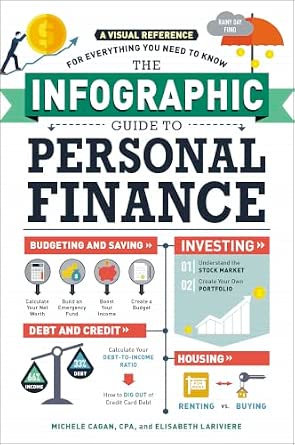
The Infographic Guide to Personal Finance: A Visual Reference for Everything You Need to Know
I’d consider this guide for visually oriented teens who prefer information presented as diagrams and infographics rather than as a conventional lesson sequence. Its visual reference format sets it apart from the activity-led Evan-Moor workbook and the beginner-focused Money Skills for Kids. That format could make it useful for browsing or revisiting a topic, but the available product details don’t identify particular subjects, age range, or whether it includes exercises. That uncertainty matters in a teen-focused roundup: I can’t confirm how much space it gives to budgeting, saving, credit, or investing, or how directly it addresses young readers. I’d treat it as a possible visual companion, not the safest choice as a teen’s sole financial-literacy resource. Choose it when presentation style is the priority and verify topic fit before buying.
Pros:- Uses an infographic format that differs from text-led guides
- Presented as a personal finance visual reference
- May suit readers who prefer visual summaries to workbook exercises
Cons:- Available product details do not identify the specific financial topics covered
- Teen suitability and age range are not specified
- The description does not indicate whether it includes activities or a step-by-step learning structure
Best for: Visually oriented teens who want a reference-style personal finance guide to browse alongside structured instruction
Not ideal for: Parents or educators who need confirmed teen-specific lessons, named topics, or hands-on activities
- Series:Infographic Guide Series
- Subject:Personal finance
- Format approach:Infographic visual reference
- Stated positioning:A visual reference guide
- Age range:Not specified in the provided product data
- ASIN:1507204663
Our verdict“Consider this as a visual companion for a teen, but choose a more clearly described book when specific money skills are the priority.”
How We Picked
I compared the 15 titles by how directly they address teen money decisions: budgeting, saving, spending, banking, credit, debt, and investing. I also looked at stated age ranges, whether a book appears designed for reading or hands-on practice, and whether its subject focus is broad or specialized. Those factors affect whether a teen can use the material independently or may need a parent, teacher, or workbook activity to make it stick.
The ranking favors accessible, broad coverage for the best overall slot, then gives distinct positions to books with a clear advantage for practice, younger learners, math-based instruction, or investing. A narrower focus is not a flaw when it suits the buyer, but it ranks below a flexible starting point for readers seeking one book to cover several core skills. Since titles and descriptions do not establish the depth or quality of every lesson, I avoid treating a topic list as proof of mastery and encourage buyers to check sample pages when available.
| financial literacy books for teen | Format | Audience |
|---|---|---|
| Financial Literacy for Teens U | Book | Teens |
| Financial Literacy Workbook fo | Workbook | Teens ages 14–18 |
| Financial Literacy for Teens a | Guide | Teens and young adults |
| Money Skills and Personal Fina | Guide | Teenagers |
| Financial Literacy for Young A | Guide | Young adults |
| 35 Money Skills Workbook for T | Workbook | — |
| Humble Math | — | — |
| The Motley Fool Investment Gui | Not specified in supplied product data | Teens |
| Financial Literacy Workbook fo | Workbook | — |
| Financial Literacy For Teens I | Guide | Teens |
| Evan-Moor Financial Literacy a | — | — |
| First to a Million: A Teenager | — | — |
| Personal Finance for Teenagers | Book | Teenagers |
| Money Skills for Kids: A Begin | — | Tweens, teens, and young adults |
| The Infographic Guide to Perso | — | — |
Factors to Consider When Choosing Financial Literacy Books For Teens
Choosing a money book is less about finding the longest topic list and more about matching the way a teen learns to the decisions they face now. I would start with the reader’s age and confidence, then decide whether practice, broad coverage, or a single skill deserves priority.
Match the Reading Level, Not Just the Age Label
Age ranges are useful starting points, but they do not tell you whether a teen prefers simple explanations or can handle more detailed material. A younger teen may benefit from a title designed for ages 12–13, while an older reader may want direct coverage of credit and investing. Avoid choosing a book solely because it says “for teens”; check the sample pages, vocabulary, and chapter length if available. A book that feels too elementary can lose an older learner, while one packed with unfamiliar terms can stall a beginner. If the reader is between levels, a guided workbook can provide a clearer path than a dense reference. Let the teen’s reading comfort and interest lead the decision.
Choose Between Reading and Practice
A guide explains ideas; a workbook asks the reader to apply them. That distinction matters because understanding a budget concept is not the same as building a workable budget. Practice-based books may suit teens who learn by filling in examples, comparing choices, or working through activities. A narrative or step-by-step guide may be easier for a reader who wants to get the big picture before doing exercises. One common mistake is buying an activity-heavy book for a teen who will not complete written tasks. If possible, ask whether the learner prefers short reading sections, prompts, or examples before selecting a format.
Prioritize the Money Decisions the Teen Faces Now
Not every teen needs the same subject first. A teen earning from a job may need budgeting, saving, and spending choices, while someone opening an account may want banking and credit basics. Investing can be engaging, but it may be less immediately useful than learning how to track income and avoid costly debt. A book that covers many subjects can serve as a shared foundation, but broad coverage may give less space to any one skill. For a specific concern, pair a general introduction with a focused title rather than expecting one book to answer every question. Choose the first topic around the next real decision the teen is likely to make.
Check How the Book Handles Numbers and Examples
Money lessons become easier to transfer when examples resemble situations teens may encounter, such as income, savings goals, borrowing, or everyday purchases. Readers who like working through calculations may benefit from consumer-math material; others may prefer plain-language explanations or visual summaries. Do not assume that a book with “investing” in its title teaches the same level of detail as a dedicated investment guide. Check whether examples explain the reasoning behind a choice or simply present a rule to follow. Look for examples that invite the teen to compare outcomes, since real financial decisions often involve tradeoffs rather than one universal answer. The right level of math should challenge the learner without turning the book into an obstacle.
Decide Whether the Book Is for Independent or Shared Learning
Some teens will read a money guide on their own; others may get more from discussing activities with a parent, caregiver, or teacher. A workbook can make shared learning easier by giving both people a concrete prompt, while a visual reference may help a teen return to a concept when a question comes up. Before buying, think about whether an adult can help with topics such as credit, taxes, or investing if the book leaves questions open. A common mistake is treating a book as a substitute for conversation about the family’s actual rules and circumstances. For independent readers, clear organization and accessible language matter more than a format that assumes group instruction. For shared use, choose material that creates useful discussion rather than simply assigning more reading.
Frequently Asked Questions
Which book should I choose if my teen has never learned about money?
I would start with a broad, accessible guide that introduces several core skills before choosing a book focused only on investing or credit. Financial Literacy for Teens Unlocked is positioned as a general guide to budgeting, saving, and investing, while the simplified and step-by-step titles may suit readers who want a more guided approach. If the teen learns by completing tasks, a workbook may be a better first choice than a standard guide. Check sample pages when available to see whether the language and activities feel approachable. The best starting book is one the teen will actually read or use.
Should I buy a workbook or a regular financial literacy book?
Choose a workbook when the teen benefits from writing, calculating, or applying ideas to examples; choose a regular guide when they want explanations they can read at their own pace. Workbooks can make budgeting and money choices feel more concrete, but they ask for active participation and may go unused if the reader dislikes written exercises. A guide can be easier to finish, though the teen may need to create their own practice. Some families may pair a general book with a short activity rather than expect one format to do everything. Match the format to the teen’s habits, not to an assumption that one format teaches better for everyone.
Is an investing book a good first money book for a teenager?
It can be a good first choice if investing is what motivates the teen, but it may leave everyday skills such as budgeting, saving, and borrowing less attention. A broad personal finance guide provides a wider foundation, while The Motley Fool Investment Guide for Teens is the more investing-focused option in this lineup. I would also check whether the teen understands basic saving and risk before treating an investing title as a complete money education. A focused book can work well alongside a general guide or a conversation with a trusted adult. Choose by interest, while keeping the limits of a specialized topic in view.
How can I tell whether a book is right for a 12- or 13-year-old?
Start with stated age guidance, then check the sample pages for vocabulary, sentence length, and the amount of independent reading expected. This roundup includes Evan-Moor Financial Literacy and Life Skills Workbook for Ages 12–13 and a consumer-math title marked for ages 12 and up, offering different approaches for younger learners. A teen who reads confidently may be ready for a broader guide, while another may prefer shorter activities and familiar examples. Avoid assuming a title is suitable just because it mentions kids or teens. If possible, let the reader preview a few pages and choose the format that feels inviting rather than childish.
Do I need a book that covers credit and debt if my teen does not have a credit card?
Not every teen needs detailed credit instruction immediately, but basic knowledge can help before they encounter borrowing, account agreements, or offers aimed at new consumers. A book that includes credit and debt may be useful for an older teen or one preparing for greater financial independence. For a younger reader, budgeting, saving, and spending may be more engaging first lessons, with credit introduced later. Avoid choosing a book only because it lists more topics; depth and readability matter too. Consider the teen’s near-term decisions and whether an adult can discuss questions the book raises.
Conclusion
My best overall choice is Financial Literacy for Teens Unlocked for readers who want a broad introduction to budgeting, saving, and investing. For best value in practical learning, I would look first at the workbook that matches the teen’s age and willingness to complete activities; the Ages 14–18 version also names credit building. For a best premium-style specialist pick, choose The Motley Fool Investment Guide for Teens when investing is the main goal, rather than expecting it to cover every money skill. Beginners who need a guided start may prefer the step-by-step or simplified guides, while younger readers can look to the age-specific Evan-Moor workbook or Money Skills for Kids. For math-focused learning, consider Humble Math; for a visual reference, consider The Infographic Guide to Personal Finance. Pick the format and subject that fit the teen’s next real money decision, then use a second book only when a clear learning gap remains.